
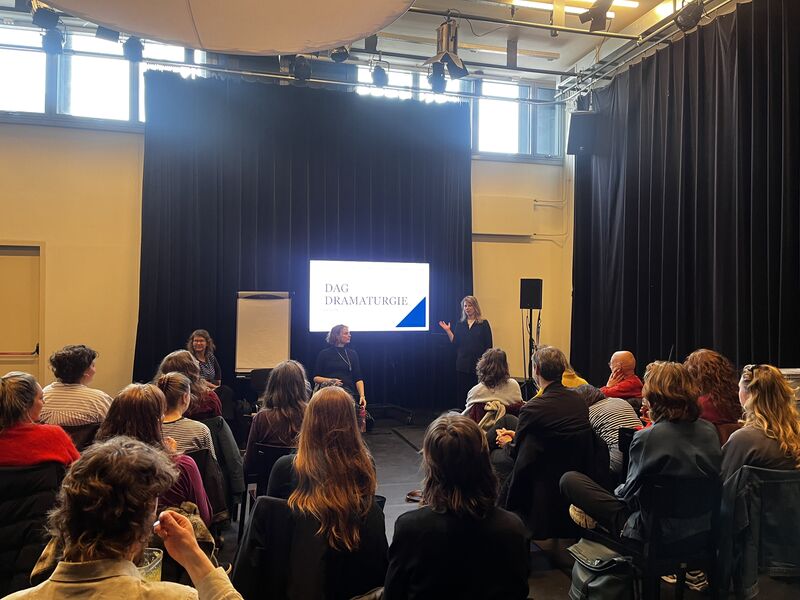
Dag Dramaturgie is een jaarlijks moment waarop dramaturgen, studenten en andere professionals uit Vlaanderen en Nederland elkaar ontmoeten om zich te richten op de verdieping en verbreding van dramaturgie als praktijk.
Zo stond in 2020 de veranderende positie van het publiek centraal, vanuit de vaststelling dat makers die steeds vaker buiten de black box werken hun publiek niet alleen als toeschouwer, maar ook als participant zien. In 2022 werd een toekomst na de pandemie bedacht: welke theatervormen zijn er ontstaan en welke dramaturgische strategieën zouden daar complementair aan zijn? Dag Dramaturgie is eigenlijk stilstaan. Met thee en koekjes en af en toe een sigaret.
Verschillende generaties en posities worden er bij elkaar gebracht. Vanuit die diversiteit ontstaat materiaal voor het gesprek. Opnieuw hanteren we hier het principe van wederkerigheid bij kennisdeling. Niet iedereen hoeft vanuit dezelfde ervaring te spreken: wat kunnen professionals leren van de perspectieven van een nieuwe generatie? Wat kan de nieuwe generatie meenemen van mensen die al in het veld staan?
Tegelijk erkennen we dat die diversiteit nog breder kan in termen van gender, culturele en etnische achtergronden. Die zijn vandaag nog onvoldoende vertegenwoordigd. Daar willen we in de toekomst verder op inzetten.
De Dag Dramaturgie 2026, Be Relevant By Doing, geleid door Floor Cremers, vertrok vanuit de fragiliteit van dramaturgie als beroepspraktijk. Vanuit de pijnlijke gewaarwording dat de positie van dramaturgen in het werkveld vaak kwetsbaar is en hun werk sterk versnipperd raakt. Vaak is de dramaturg ook de eerste functie die geschrapt wordt bij besparingen. De bijdrage van de dramaturg wordt niet altijd zichtbaar. In hoeverre draagt die beperkte zichtbaarheid eraan bij dat de relevantie van de dramaturgische praktijk in vraag wordt gesteld? De titel probeert hierop een antwoord te formuleren vanuit een constructief perspectief: wat gebeurt er wanneer we het belang van dramaturgie niet alleen proberen te bepleiten via beleidsmatige actieplannen, maar de praktijk van dramaturgen zelf zichtbaarder maken?
En die praktijk is uitermate divers. Dramaturgie kan een artistiek concept verdiepen, bronnen aandragen, de vormelijke vertaling van dat concept kritisch opvolgen of ook soms alle logica loslaten en het buikgevoel laten spreken over wat wel en niet werkt op de vloer. Maar ook kan de job eruit bestaan een maker te bevestigen wanneer die onzeker wordt over het werk. De praktijk van een dramaturg beweegt zich evengoed rond de relaties en omstandigheden waarin het materiaal ontstaat.
Dramaturgisch werk vindt plaats tijdens het proces en laat zich achteraf niet aan één persoon toeschrijven. Een manier om die onzichtbaarheid te doorbreken zonder het werk op de vloer zelf te veranderen, is door er achteraf over te schrijven en zo die kennis te delen. Liesbeth Groot Nibbelink doet dat in haar onderzoek naar dramaturgische methodes, en ook Elioa Steffen maakt haar praktijk toegankelijk door onderzoek en publicatie, waarbij ze verschillende dramaturgen en perspectieven samenbrengt. Die veelheid aan stemmen vinden wij belangrijk: ze maken ruimte voor een meervoudiger beeld van wat dramaturgie kan zijn en politiseren die blik.
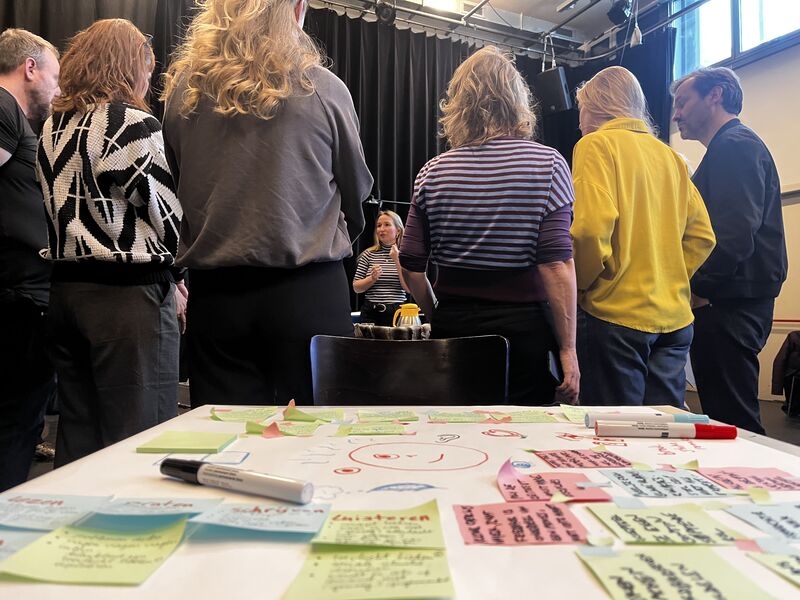
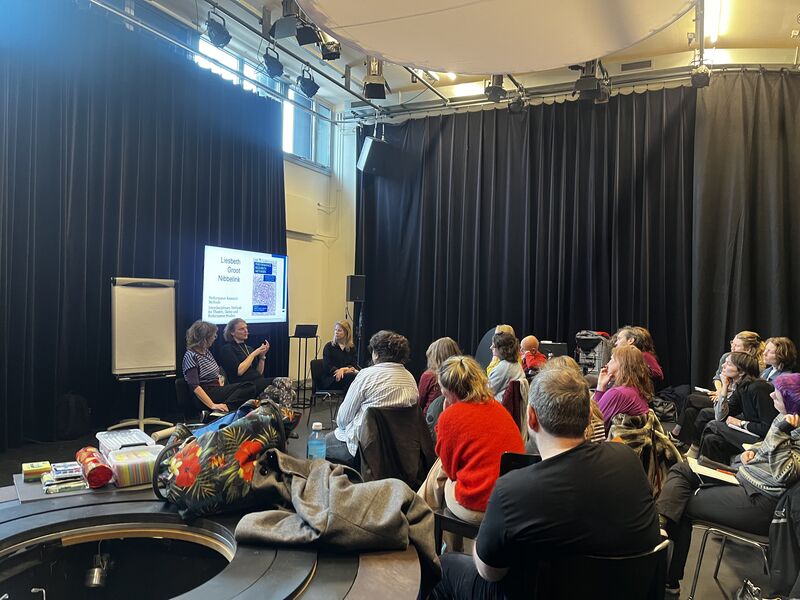
Tijdens de workshop over dramaturgie van Liesbeth Groot Nibbelink verschoof de aandacht van wat dramaturgen doen naar de kennis die daarin besloten ligt. Door dramaturgische praktijken te onderzoeken en te delen, kan deze expertise uitgroeien tot een collectieve kennisbasis waarin dramaturgen elkaars werkwijzen verder kunnen ontwikkelen.
Elioa Steffen benaderde diezelfde beweging vanuit een andere hoek. In A Queer Feedback Handbook wordt de manier waarop feedback als praktijk wordt vormgegeven, onderzocht: welke verhoudingen spelen mee in een feedbackmoment, en hoe kunnen verschillende vormen van feedback worden ontwikkeld? Steffen’s behandelde de voorwaarden waaronder kritiek kan circuleren.
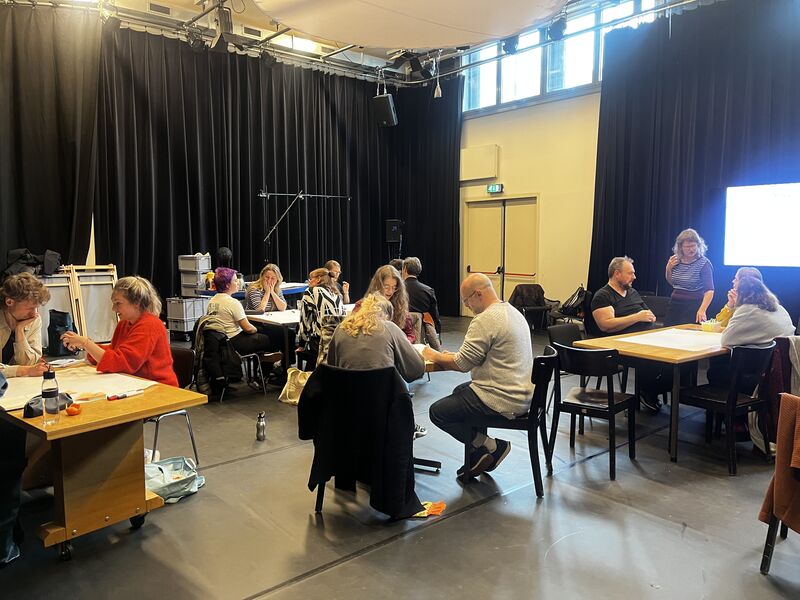
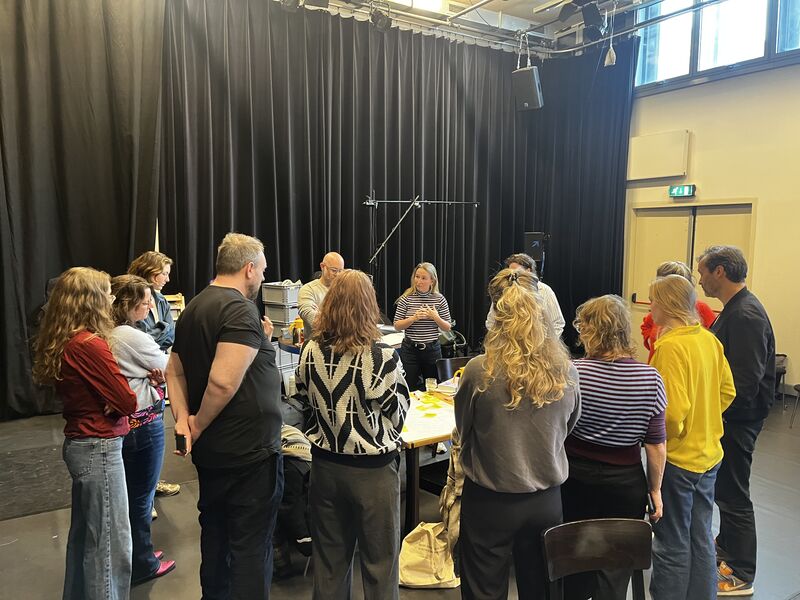
Aan het einde van de dag werd een bronarchief opgemaakt. Deelnemers brachten bronnen mee die hun eigen praktijk voeden en maakten die tijdelijk onderdeel van een gedeelde ruimte. Daarmee werd opnieuw individuele kennis collectief gemaakt, op een ander niveau. (zie onderaan de pagina voor de gedeelde bibliotheek!)
Dag Dramaturgie kan een plek zijn waar een praktijk zich verspreidt en deelbaar maakt. De waarde van zo'n dag zit ook in wat daarna verder gaat: een methode die wordt meegenomen op de vloer, een bron die onderdeel wordt van een nieuwe samenwerking, of een vriendschap/ samenwerking die er ontstaat.
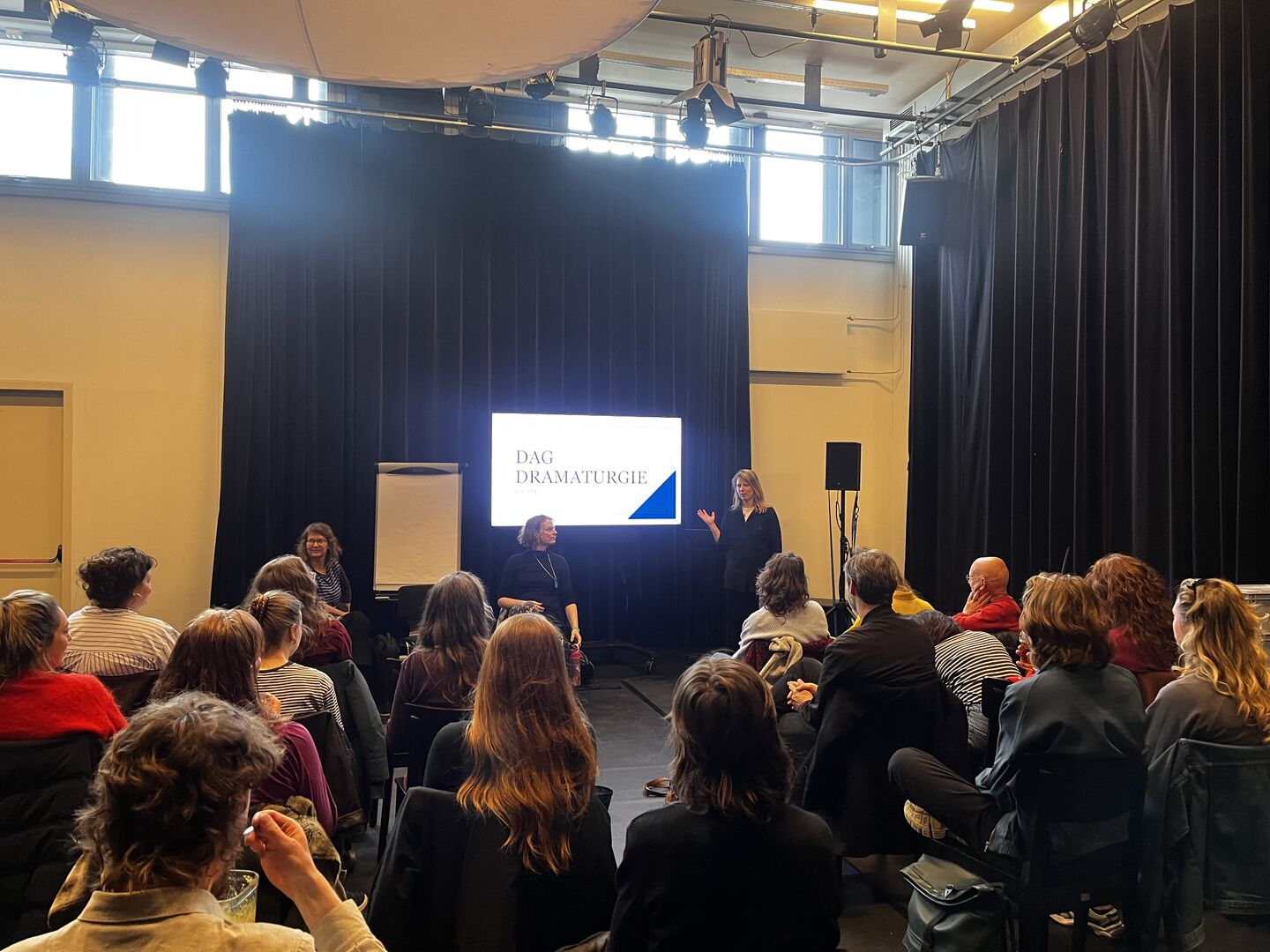
Dear all,
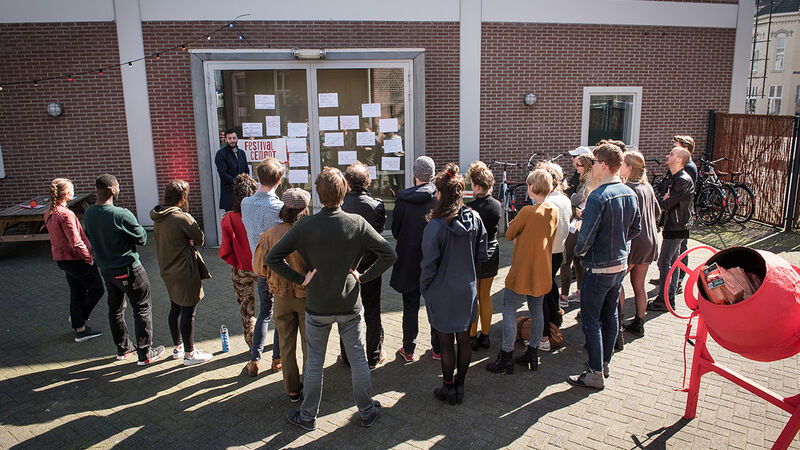
First of all, I would like to welcome you here at Festival Cement, to this professionals program for dramaturgs, de Dag Dramaturgie.
My name is Floor Cremers, I am a dramaturg, freelancer, currently working for seven different organizations, 12 if you count the unpaid labour or volunteer work, and I’m still not working full time by the way. It’s to much to list, would be a waste of your time, come talk to me after if you are interested. Even though I have so many employers, I’m still not working full time, and for not even half the time, I’m doing the work that I’m actually trained for. Although my network is extensive and I feel I can’t complain about my total income, I do feel vulnerable in the work that I do. I graduated in 2018, and over the past years, I found it harder to find employment.
I’m also standing here as the secretary of a new association that has been founded this year, for people with a dramaturgical practice, or with affinity with dramaturgy. It’s called MoMo, short for Motorisch Moment. Become a member, if you are not already part of the club.
My own sense of precarity is one of the reasons why I’m currently advocating through MoMo, for a dramaturgy department as a vital part of any organisation and the dramaturg as a most necessary contributor to what I would call and refer to as generous criticism, in the performing arts field. last year we explored the concept of critical generosity on this professionals day for dramaturgy, that was hosted by Eylül Fidan Akıncı and Lara van Lookeren. It represents a collaborative, ethical approach to theater-making that prioritizes curiosity, care, and the nurturing of artistic work over solely evaluative or judgmental critique. Today with Elioa we’ll dive more into the concept of feedback, and I feel it is something that also resonates within their work.
For the past 1,5 years I’ve been listening to our common experiences, stories, anecdotes, and all the ways in which we experience our job as precarious. The decline in job opportunities, the budget cuts and how smaller contracts and lower fees derive from that, having to always advocate for yourself, standing up for your added value, your contribution to the project, your relevance. Despite my extensive network, I still sometimes feel invisible and redundant in my search for job opportunities as a dramaturg.
When thinking about what this association could be, I spoke to one of our dear colleagues, who stopped me for a moment, saying she was also a bit tired of this narrative of the precarious position dramaturges are in. Instead of looking at it from a negative standpoint, from a position of precariousness, in which we ask the rest of the field to see us, to support us, to stand up for us, she said: We need to be relevant by doing our jobs. And that resonated with me. Can we rethink this position that we find ourselves in and change the narrative? Instead of departing from a position of scarcity, can we turn it into a story of abundance?
Because every time I talk to every one of you, my colleagues, I’m amazed by all the incredible work that you do. By your level of insight and reflection, your sharp analysis, by all the research that is collectively done, big or small, published or invisible, or maybe only shared with the small group of people that are part of your artistic process. Through conversations with you I sharpen my mind, I learn, I grow and rediscover my sense of urgency in making art. Live art.
Whenever I’m down. I call on you my friend. A helping hand you lend, in my time of need.
- From the song My Friend, by Groove Armada –
So when asked to host and organize this professionals program today, that’s what I wanted to do. I wanted to, selfishly, learn from you, and give back what I have to offer. And to say that we are relevant, because we practice. Because collectively, in our work we continuously shape and reshape the performing arts field. And what we do deserves more visibility and deserves to be shared. So I decided to share the stage today, and invite two amazing people, that do incredible work that I’m most curious about; Elioa Steffen and Liesbeth Groot Nibbelink. They will work with you this afternoon to sharpen the tools you already have. Together, guided by our guests, we will further explore our own practice, our own gaze, define our methodology and practice critical generosity through exploring feedback practice.
Books
White Fragility, Robin Diangelo. Beacon Press [2018]
Man & Macht, Kate Manne, vertaald door Marianne Palm. Atlas Contact [2020]
The Argonauts, Maggie Nelson. Melville House UK [2016]
Consent, Vanessa Springora, vertaald door Natasha Lehrer. Fourth Estate Ltd [2022]
Upstream, selected essays. Mary Oliver. Penguin House [2019]
All of this unreal time. Max Porter. Rough Trade Books [2024]
A Midsummer night’s dream. Shakespeare. Edited by Sukanta Chaudhuri [Not about this specific text, but as a symbol for going to the source text first]
Ek en my Mense. Saamgestel deur Han Sans.
De wereld waarnemen. Maurice Merleau-Ponty. Vertaald door Jenny Slatman. Boom uitgeverij [2003]
Een kamer voor jezelf. Virginia Woolf. Vertaling door Monique ter Berg. Uitgeverij Chaos [2018]
Je hebt geen kans, maar pak ‘m. Paul Slangen. Int. Theatre & Film Books [2025]
For Emplacement. Political ontology in two acts. Mario Blaser. Duke University Press [2025]
De taal van de toeschouwer. Marieke Dijkwel, Simone van Hulst en Tobias Kokkelmans. Academie voor Theater en Dans & De Nieuwe Toneelbibliotheek [2017]
Tienduizend idioten. Nirav Christophe. Uitgeverij it&fb i.s.m. HKU [2018]
The mushroom at the end of the world. Anna Lowenhaupt Tsing. Tantor Audio [2021]
Het Theaterfestival 1998. Essays over acteerstijlen. Tom Blokdijk, Karin van Herwijnen, Ellen Walraven. [Omdat dramaturgie voor mij ook verbinden is en elkaar en elkaars functies begrijpen.]
De vloek van de nootmuskaat. Amitav Ghosh. Atlas Contact [2023] [Klimaatcrisis heeft een storytelling probleem. Dramaturgen kunnen narratieven bevragen, hervormen, herscheppen].
Talking Dramaturgy. A Zine.
Talking Dramaturgy. Another Zine.
Artificial Hells. Claire Bishop. Verso Books [2023] (new edition).
A Queer Feedback Handbook. Elioa SteƯen & Szymon Adamczak. IPOP. [2024]
Performance Research Methods. Liesbeth Groot Nibbelink en Laura Karreman. Open Book publishers [2025]
The Book of symbols. Reflections on Archetypal images. Taschen [2010]
Girlhood. Melissa Febos. Bloomsbury Publishing Usa [2022]
Staying with the trouble. Donna Haraway. Duke University Press [2016]
The story of art without men. Katy Hessel. Hutchinson Heinemann [2022]
Not so black & white. Kenan Malik. W. F. Howes Ltd [2023]
Metaphors we live by. George LakoƯ & Mark Johnson. University of Chicago Press [2003]
On connection. Kae Tempest. Faber & Faber [2022]
The haunted stage. Marvin Carlson. UNMI [2003]
Prosthetic Memory. The Transformation of American Remembrance in the Age of Mass Culture. Alison Landsberg. Columbia University Press [2004]
Six memos for the next Millennium. Italo Calvino. Vertaald door: Patrick Creagh, Martin Mclaughlin, William Weaver. Mariner Books Classics [2016]
Rabelais and His World. Mikhail Bakhtin. Translated by Helene Iswolsky. Indiana University Press Bloomington [1984] [Introduction text].
Deaf Republic. Ilya Kaminsky. Highbridge Audio [2019]
Podcast
How to survive the end of the world - https://endoftheworldshow.org/
Spark & Fire: Fuel your creativity - https://sparkandfire.com/
TAIT – Talking about immersive Theater - https://toolkitfortheinbetween.com/external-links/tait-talking-about-immersive-theatre-podcast-series/
The temporal imagination - https://www.sunkhronos.org/podcasts/the-temporal-imagination
Ervaring voor beginners - https://podcastluisteren.nl/pod/Ervaring-voor-Beginners
Journalism
Newsletter Meditations in an Emergency | Rebecca Solnit - www.meditationsinanemergency.com
Klimaat is geen hot topic meer. Volkskrant 19/03/2026
Documentaire Meer dan babi pangang. Julie NG. San Fu Maltha, Julie Ng, In-soo Radstake [2025]
Jacobin. “Your Identity isn’t private property.” Édouard Louis. [2024] https://jacobin.com/2024/04/edouard-louis-identity-private-property/
Film
Hamnet. Chloé Zhao. Maggie O’Farrell. [2025]
Other notes